
You stare at the kitchen backsplash, which is currently a peeling, dated mosaic from 1994, and realize that the leak under the sink isn’t just a nuisance, it is a slow-motion disaster that might eventually rot your subfloor. You have the Pinterest board ready, the contractor has given you a verbal estimate that makes your eyes water, and your savings account is currently playing hide-and-seek with your mortgage payment. This is the moment where the dream of a renovation hits the hard reality of math.
Most people think they need a massive, life-altering windfall to fix their homes, but that isn’t how it works for most of us. You don’t need a windfall; you need a strategic way to bridge the gap between your current bank balance and the cost of new countertops. We have seen people try to juggle this using nothing but high-interest credit cards, only to find themselves buried in interest payments before the first tile is even laid.
Financing is a tool, but if you use it poorly, it becomes a debt trap. If you use it correctly, it becomes the engine that turns a crumbling fixer-upper into a functional living space. We want to look at the actual mechanics of how people are paying for these projects in 2026, specifically focusing on how unsecured loans compare to the alternatives.
Unsecured vs. Secured: Knowing Your Risk Profile
The biggest distinction in this space is whether you are putting your house on the line to get the cash. This is the divide between personal loans and home equity products. A personal loan for home improvement is an unsecured debt, meaning the lender doesn’t have a claim on your property if you stop making payments. This makes the approval process faster and the paperwork much lighter, but it often comes with a higher interest rate because the bank is taking on more risk.
On the other side, you have home equity loans or HELOCs, which are secured by your house. These usually offer lower rates because the bank knows they can foreclose if things go south. However, you are essentially betting your roof that you can pay back the debt. If you are doing a small cosmetic fix, like painting or replacing light fixtures, a secured loan is usually overkill and carries too much risk for the reward.
Personal loans are essentially unsecured personal loans that you use to pay for home renovations and repairs. Because they don’t require collateral, you can often get the funds in your account within a few business days. This speed is vital if you have a contractor who is ready to start on Monday but won’t wait for a bank to appraise your property for a home equity line of.
We see a lot of confusion here. People often think they need a massive loan for a massive project, but the math rarely supports that. If you are just trying to fix a leaky roof, you might not need to tap into your home’s equity at all. Sometimes, a smaller, quick-access loan is the smarter move to prevent a small leak from becoming a structural nightmare.
The Financing Menu: Comparing Your Real Options
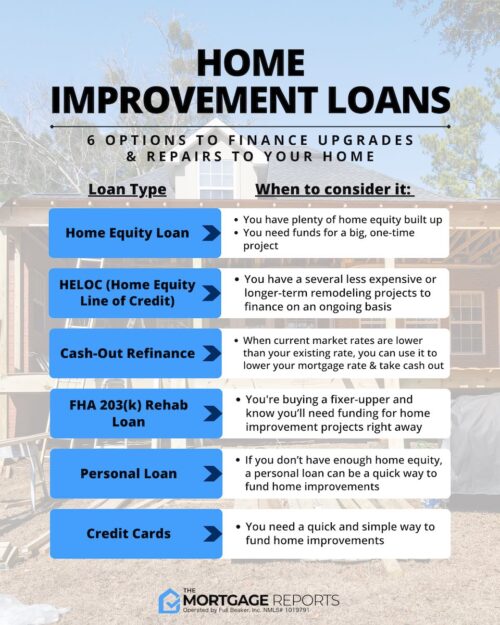
You aren’t limited to just one way to pay for a new deck or a bathroom remodel. Different projects require different financial tools, and using the wrong one is a fast way to ruin your credit score. It is a bit like trying to use a sledgehammer to hang a picture frame; it works, but you are going to cause a lot of unnecessary damage if you aren’t careful.
Credit cards are the most immediate option, but they are also the most dangerous. If you can pay the balance in full every month, the “interest” is basically zero. But if you’re carrying that balance for three years while you pay off the renovation, the 22% APR will eat your home equity alive. We recommend keeping credit cards strictly for small repairs or as a backup for unexpected costs that pop up mid-renovation.
Home equity financing is another heavy hitter. As noted by The Wall Street Journal, you can cover home improvement projects with personal loans, credit cards, or home equity financing, but you must compare rates and terms to get the best deal.
Here is a quick breakdown of how these options typically stack up for the average homeowner:
| Financing Type | Speed of Funding | Risk Level | Typical Use Case |
|---|---|---|---|
| Personal Loan | Fast (Days) | Medium (Unsecured) | Mid-sized renos, repairs, upgrades |
| HELOC/Home Equity | Slow (Weeks) | High (Secured) | Major additions, kitchen overhauls |
| Credit Card | Instant | Medium (Unsecured) | Small fixes, unexpected parts |
| Cash Savings | Instant | Low | Small, non-essential cosmetic work |
When we look at the math, the “best” option isn’t always the one with the lowest interest rate. It’s the one that matches the lifecycle of the project. If you are doing a kitchen, you know exactly how much it costs, so a fixed-rate personal loan is great. If you are doing an ongoing remodel where costs change every week, a line of credit might be more flexible.
Hidden Costs and the “Scope Creep” Trap
Every renovation project has a tendency to expand once the walls are opened up. You start by wanting new cabinets, then you realize the plumbing is shot, then the electrical needs an upgrade to handle the new appliances, and suddenly your $10,000 project is a $25,000 nightmare that has left your house looking like a construction zone for six months. This is called “scope creep,” and it is the primary reason people end up in debt trouble.
Always borrow less than you think you need. If your contractor says the job will cost $15,000, you should be looking at a loan for $18,000 or $20,000. You need a buffer for the “oh no” moments. If you take out a loan for exactly what you think you’ll spend, and then the contractor finds rot in the wall, you are stuck with a half-finished project and no way to pay the guy to finish it.
We suggest checking your local building permits before you sign a loan agreement. If you need a permit and haven’t accounted for the cost or the time, your project timeline will slip, and your loan interest will start ticking while your house is still a mess. It is a frustrating cycle that many homeowners fall into because they focus on the aesthetic outcome rather than the administrative reality (and yes, the paperwork is usually boring but absolutely vital).
One way to mitigate this risk is to use a loan with a fixed rate. Variable rates are tempting when they look lower on paper, but if the economy shifts and your monthly payment jumps up by $200, your renovation just became a lot more expensive. A fixed rate provides the certainty you need to budget for the long haul.
The Reality of Resale Value and ROI
The most common argument for borrowing money to fix a house is that the renovation will pay for itself when you sell. This is a half-truth. Not every renovation provides a Return on Investment (ROI). A high-end, designer kitchen in a mid-range neighborhood is a terrible investment. You will spend $60,000 to add $30,000 in value. You might be happier living in it, but you won’t get your money back.
Some projects are safer bets than others. Generally, things that fix “problems” have a better ROI than things that just look pretty. A new roof, a modernized HVAC system, or a repaired foundation are “defensive” renovations. They protect your investment. On the other hand, a new deck or a bathroom refresh are “offensive” renovations; they are meant to make the home more attractive to a specific type of buyer.
Before you take out a massive personal loan, look at the “comps” in your neighborhood. If every house on your street has a standard granite countertop, don’t go out and install rare Italian marble. You are simply over-improving for the area. The goal should be to stay within the “sweet spot” of your local market’s expectations.
If you’re planning to stay in the house for at least five to seven years, the ROI argument matters less than your personal enjoyment. If you love the kitchen, then the debt is a lifestyle choice. If you are doing it just to flip the house or sell it, then you need to be a cold-blooded mathematician about every dollar you borrow.
The one thing people always ask is: “What if I can’t afford the monthly payment if interest rates rise?” If you choose an unsecured personal loan with a fixed rate, your payment stays exactly the same for the life of the loan, which eliminates that specific fear entirely. There’s a useful breakdown over at texasloanstoday.com.
Common questions
Can I use a personal loan for home improvements?
Yes, personal loans are unsecured funds that can be used for any purpose, including home renovations, repairs, or landscaping.
Is a personal loan better than a home equity loan for remodeling?
Personal loans offer faster funding and no collateral, whereas home equity loans typically have lower rates but require your home as security.
How much can I borrow for home improvement with a personal loan?
Borrowing limits vary by lender and your credit score, but most personal loans offer between $2,000 and $50,000.
Will a personal loan affect my mortgage eligibility?
Taking out a personal loan increases your total debt, which can lower your debt-to-income ratio and impact your ability to qualify for a mortgage.
Are there any downsides to using a personal loan for home repairs?
The primary downsides are typically higher interest rates compared to secured loans and the potential for high monthly payments if the term is short.